Don’t go fishing without a hook
The White Lotus opens not in tropical paradise, but in an airport departure lounge.
A man sits alone, visibly shaken after his Hawaiian honeymoon.
He twiddles his wedding ring as he waits uneasily.
A friendly couple opposite him tries to make polite conversation.
“Which hotel were you at?” they ask.
“White Lotus” he responds.
“Our guide told us someone was… killed there.”
“The body’s on our plane,” he replies.
“Where’s your wife?” the friendly couple asks.
The man pauses, slips his sunglasses on, then responds.
“No offense. Leave me the fuck alone.”
I just described the opening minute of the hit HBO show, The White Lotus, and honestly, it’s impossible not to be pulled in from there.
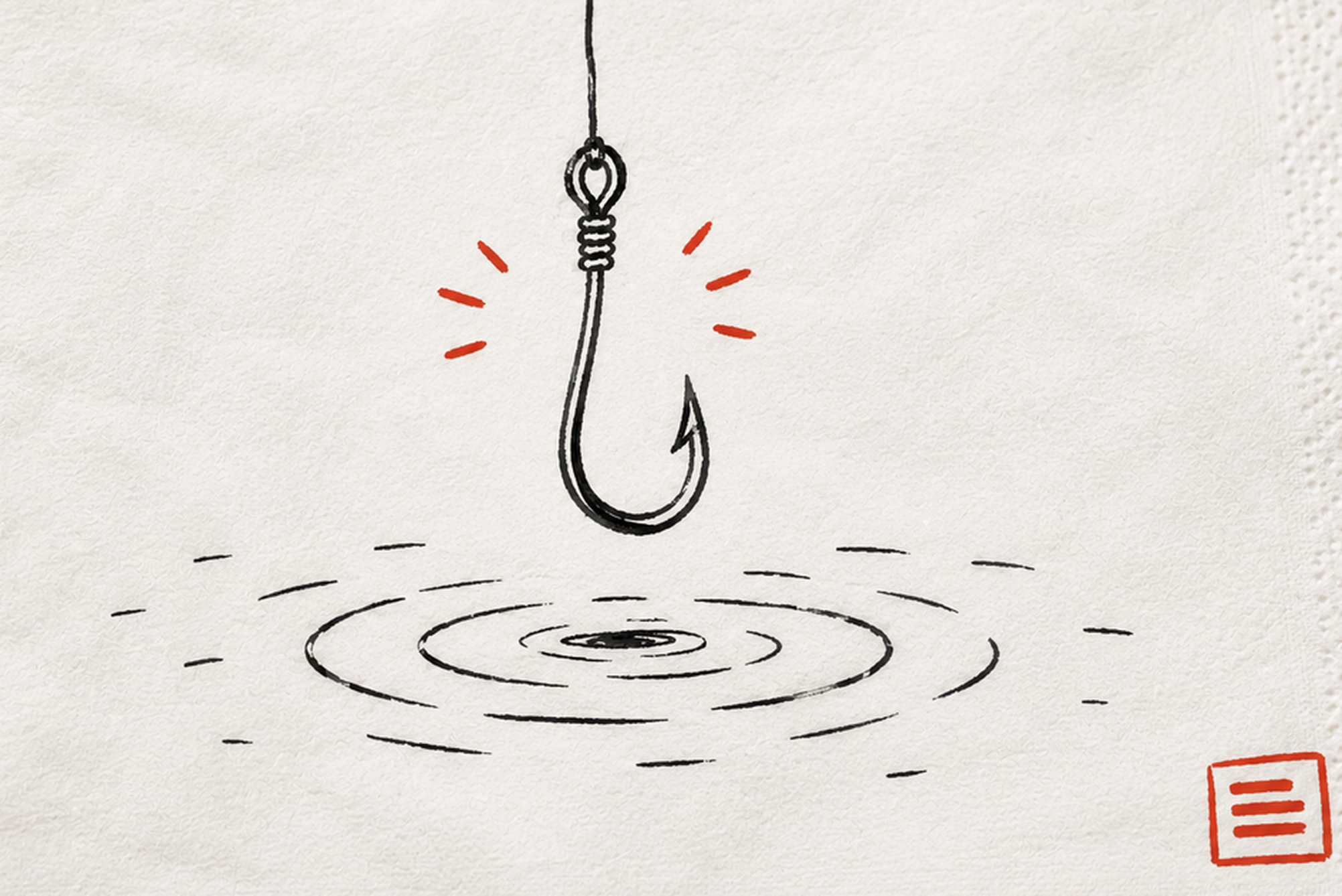
That’s a hook.
A narrative device that does one vital thing.
Tells you, as the audience, not to go anywhere.
To put everything down and keep watching. To stay tuned.
The hook is an incredibly effective component of storytelling,so much so that I actually think it’s the most important part. It’s also the part that founders most often miss when putting together their pitch deck.
In The White Lotus the hook is effective because it creates suspense. You don’t know how an idyllic vacation in paradise possibly ends in tragedy. You want to know who died and how it happened.
You have suspicions immediately, the newlywed husband, but surely that’s too easy right?
One thing’s for sure, you need to keep watching so you can figure out the mystery. Every scene from this point forward might be an important clue. It could just as easily be a red herring. Either way, you now have a reason to keep watching scene after scene, episode after episode to resolve it.
Here’s the actual mechanism at work:
Hook → open loop → discomfort → attention
The hook plants a question. That question creates what psychologists call an “open loop,” an unresolved thread. Open loops produce real discomfort. Our brains just HATE them. And the only way to resolve that discomfort is to keep paying attention until the loop closes.
That’s why we’re compelled to watch until the end. We just have to know what happens next.
It’s an implicit contract between the show and the audience: stick with me, and I promise this story will answer a question worth caring about.
Your brain doesn’t reserve this reaction for TV. It runs the same open loop the moment anyone starts a story and leaves a question hanging, including an investor sitting across from you at a pitch meeting.
That’s exactly what your pitch needs to do: open a loop investors need closed, and make finding out feel urgent.
Most pitches start on boring autopilot: Company name, jargony tag line, vague mission statement, generic problem, complex solution, exaggerated market size. Yawn.
By the time anything interesting shows up, the investor’s eyes have glazed over and they’ve already moved on. It happens so fast, too. You don’t get a slow burn. You get 60 seconds ... if you’re lucky.
It doesn’t matter if it’s TV, the movies or a pitch deck: A good hook grabs attention and earns the right to keep it.
A pitch should be a story, not a walkthrough of your company.
An investor has infinite opportunities and a finite amount of time and capital. Earn their attention in slide 1, minute 1.
Then let the rest of the deck back it up.
How do you do this? We’ll cover it next week. I hope I gave you a reason to stick with me.
Until next time,
-Carl