Your Investor Deck Is Not Your Sales Deck

Investors want a return. Customers want their pain gone. Why would you tell them the same story?
The best man at every wedding has the same problem.
He has to make one speech for two different audiences: his buddies from the bachelor party, and the bride’s grandmother in the front row.
If you tell a bachelor party story to the first group you’ll get laughs and high-fives. Tell it to Grannie, and you might get cancelled.
The best man is stuck with one speech for both audiences. Luckily, founders don’t have that constraint.
Think about sales pitches versus your investor pitches. Your investors and your customers exist in different worlds and they care about different things. So why would you tell them the same story?
Investors want to make a return. Customers want to solve a business problem.
That’s not an insignificant difference and it changes the whole narrative arc.
Different goal → different setup → different arc → different conclusion.
Investors are looking for that 1 in a 100 investment that gets them promoted to partner and delivers a great return for their investors. Your deck’s job is to show them why your thesis makes sense and why the opportunity could be massive. Every slide builds toward one conclusion: this could return the fund.
Customers don’t care if you’re massive, venture-backed, or have ARR up the wazoo. They care if you can make their lives easier. Open with the problem they’re already living with, said in their words-then prove you can fix it.
Here’s what that looks like:
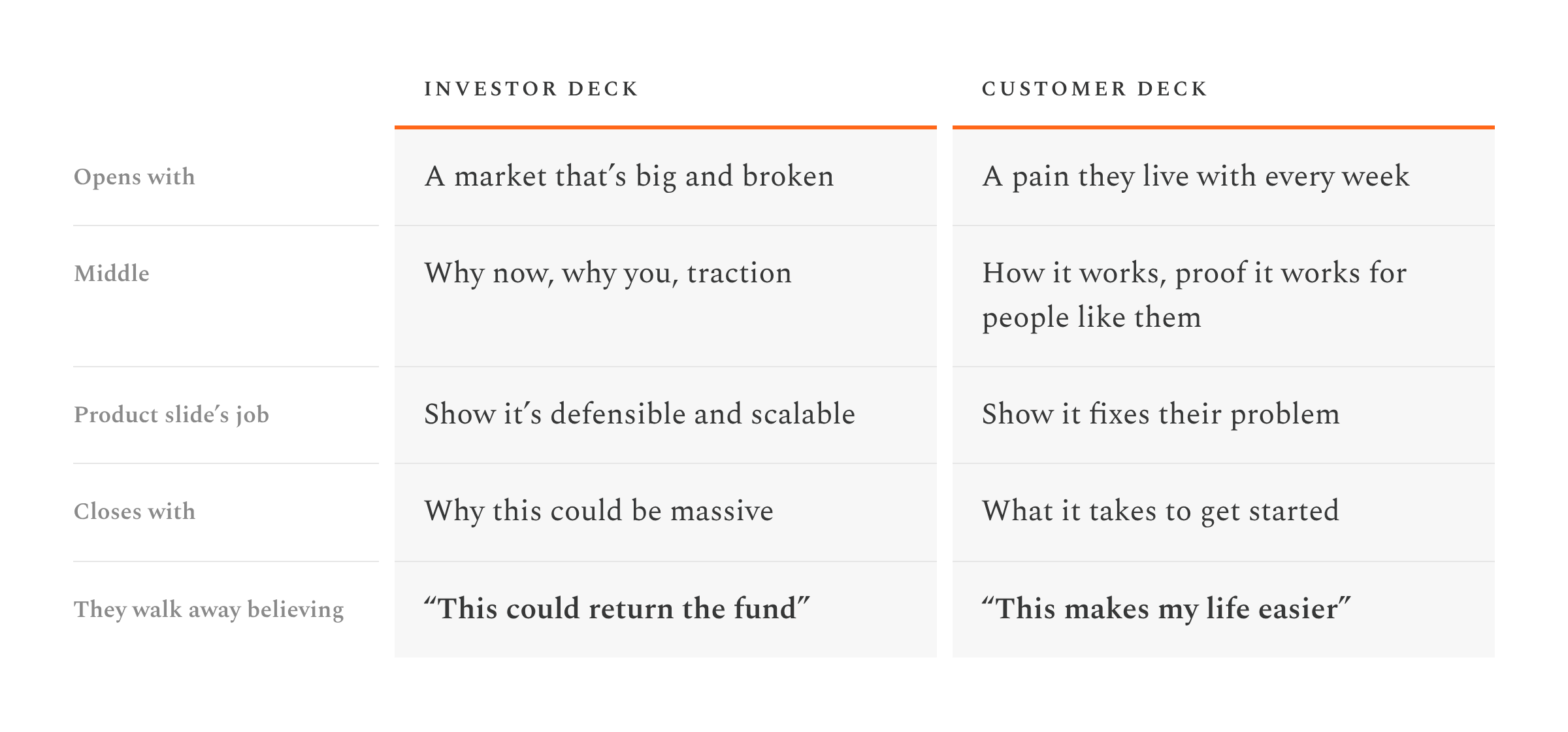
Look at the product slide, for example. It does belong in both decks but it plays a different role in each story.
Say you’re building K-12 EdTech software. Your product slide says, “Our adaptive engine personalizes learning paths across 30 skill areas.”
It’s not a bad slide. It’s just written for nobody in particular.
In the investor deck, it becomes: “Our adaptive engine personalizes learning across 30 skill areas. 40 districts in 18 months, with sales cycles down from 9 months to 4.”
In the customer deck, it becomes: “Teachers lose their Sunday nights to lesson planning. Here’s how to give them back.”
It’s the same product told in two different ways.
If your investor deck and your sales deck look similar, one of them is wrong.
And here’s why it matters even more than you think. The first person you talk to is rarely the one who decides. An investor has to retell your story to their partners, who want to know about returns. A superintendent has to retell it to the school board, who want to know about teachers. Both of them need a story they can run up the flagpole.
Your job is to know who you are pitching to. And before a deck goes in front of anyone, know what they need to believe. Then, build the story backward from there.
The best man has to thread the needle between the groomsmen and Grandma. You don’t.
Figure out who’s in the front row, and write for them.
The Napkin shares one fundraising or storytelling idea for founders, every week. Carl Fudge is the founder of Presentation Mode, where he's helped founders raise over $1B in venture capital.
Subscribe to The Napkin →