You lost them before slide 1.
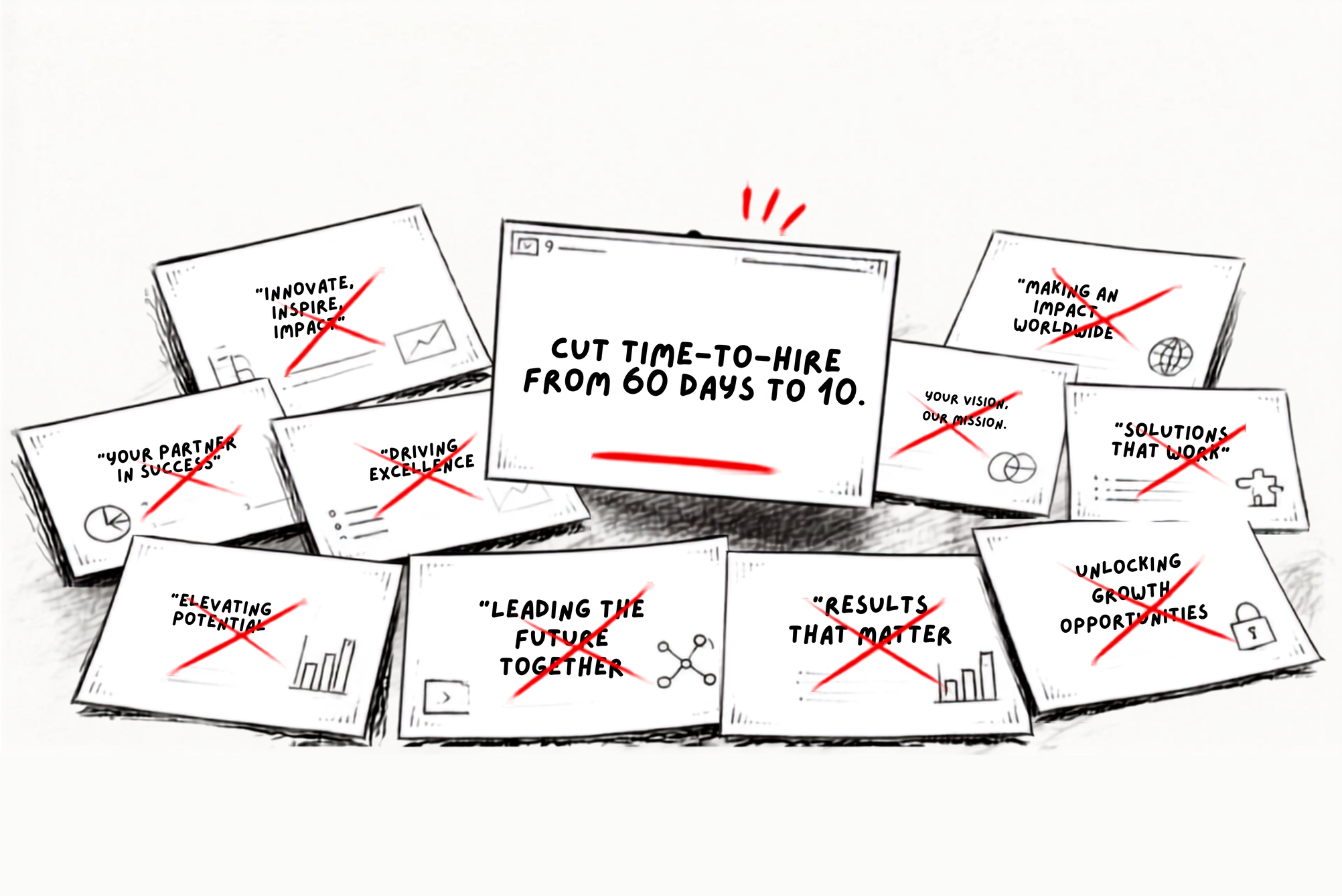
Your pitch begins before you think it does.
You’re a founder who has spent weeks on your pitch. You’ve workshopped the problem, refined the narrative and agonized over slide design.
Finally, it feels good to ship.
And then you slap a generic tagline on the title slide and call it done.
Or even worse, you use the title slide as some sort of catch-all summary of the whole idea, before anyone has any context.
That’s a mistake.
Because before anyone has even opened your deck, your title slide is already doing a job. Doing it poorly can cost you dearly.
Here’s what’s actually happening when an investor receives your deck.
They’re trying to answer two questions, almost unconsciously:
- Is this problem interesting?
- Is this solution unique?
That title slide has roughly 3 seconds to answer both. If it can’t, you’re already playing catch-up, and chances are, the decision-making process is already kicking into overdrive.
Too many title slides fail this test, and a lot of times, it’s because it’s an afterthought. Something has to fill the space above the logo. A description of what the company does rather than why it exists.
A founder came to me recently with a tagline that read “IRL for wellness.” Even before diving into the company, I’m already thinking to myself, ‘Wellness has always kind of been IRL, right?’ That alone isn’t novel. It’s not a point of view, and it doesn’t tell me why this company needs to exist or why I should keep reading.
It’s like an HR tech company whose tagline reads “Empowering Workplaces Through Technology.”
How is it empowering? Which workplaces? Through what technology? I’ve already got a lot of questions.
Compare that to: “Cutting time-to-hire from 60 days to 10.”
It takes up the same amount of real estate on the slide. You immediately know what the company does, who it’s for, and what makes it different. It’s a clear outcome, and the special sauce is right there in the tagline.
That’s what a title slide should do.
Think of it like the hook before the hook. Your pitch should be a story, and the tagline is the opening line. Either you earn the next sentence, or you don’t.
Most founders treat the tagline as the last thing. It should be the last thing, but only because it’s the distillation of everything that came before it. If the story is clear, the tagline almost writes itself. If it doesn’t, that’s your real problem.
The formula is simpler than most founders make, too: outcome plus special sauce. I don’t want to know what you are. I need to know what you deliver, and why no one else delivers it that way.
I’ve got some personal experience with this one, too. I learned the hard way with my own company. Our original tagline was “Pitch Perfect Presentations.” We ended up so focused on the slides themselves that we missed the point of what we were actually selling.
That’s how we eventually landed on “Own the Room.” Because that’s the outcome, and that’s what founders actually want when they walk into a pitch meeting.
The deck is the vehicle. Make sure your title slide tells them where you’re taking them.
-Carl