Your pitch made sense. Until it didn’t.
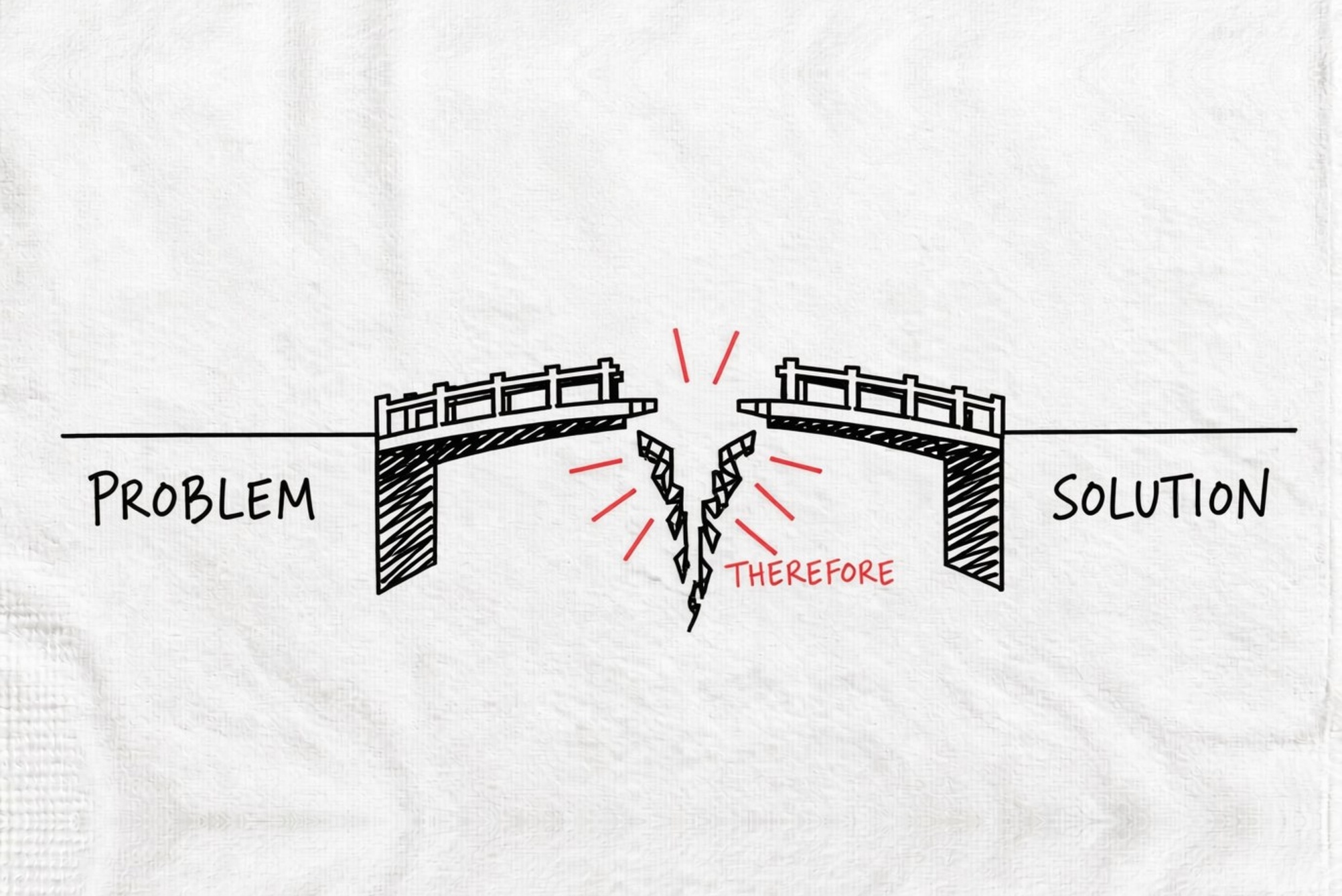
Most pitch decks have facts.
Some have stories.
Very few have clear logic.
Pitching comes down to one thing: taking investors on a journey where by the end of the pitch, they agree with your view of the world.
If you can, you’re off to the races. If you can’t, you’re not getting out of the starting gate.
When the logic in your pitch breaks down though, investors pounce. The nodding slows, and the questions get harder. The energy in the room changes, and you can feel it.
Investors might not even be able to explain why.
But our brains are remarkably good at spotting logical inconsistencies, even if we can’t name them. Here’s how it works:
Broken reasoning --> Unease --> Skepticism --> disengagement.
What’s maddening is most founders don’t even realize their logic is broken. Usually because they’re too close to their own company. Every step feels obvious, and every connection feels self-evident.
To them.
It’s not obvious to the investor sitting across from them, though.
I worked with a founder pitching a home robotics company. Their opening claim: One day, we’ll all have robots in our homes.
That sounded absurd to most people in the room. But that’s the point. They paired a bold, futuristic vision with logic.
We already have dishwashers -- robots for dishes. We have smart homes, self-driving cars; we’ve automated just about everything. As anyone who’s hand-scrubbed dishes can attest, we’ve always looked for ways to offload repetitive, physical work of daily life. That’s not a new human desire.
Therefore, the market for home robotics has always existed in principle.
That used to only exist in “The Jetsons.” Until now. A recent breakthrough in replicating the mechanical complexity of human hand movements — the millions of nerves, grips, and positions that previously made robotics impractical for household tasks — changed that.
Therefore, what once seemed impossible is now viable.
Therefore, this company needs to exist right now.
By the end of that pitch, the room was convinced. What started as an absurd premise had become something that went beyond possible. It started to feel inevitable. That’s the result of logic. A non-consensus idea ends up feeling obvious.
Too many pitches fall apart because the one step doesn’t logically follow from the last.
”Healthcare is broken therefore we’re building a digital health concierge.”
Huh? There’s a a logical gap a mile wide between those two statements. Why does this problem require this specific solution?
Your pitch is an argument. Make it a logical one.
-Carl